

At Control Alt Delete we build Magento webshops every day. A lot of that work is specific to one client, but underneath the custom work the same technical questions keep coming back. If multiple agencies run into the same problem, why would every agency build and maintain its own solution? That question was the core of my part of the presentation at Meet Magento Netherlands, and Mago is what came out of it.
Mago is the AI admin assistant for Magento 2. Control Alt Delete led the development, together with Linted, Made by Mouses, Magmodules and Vendic, with Mage-OS as neutral ground. Here is what it brings, and why the way we built it matters.

Ask your store anything
As a store owner you ask questions the way you would ask a colleague. What were our best sellers this week? How many orders came in from Belgium? Which payment methods are customers actually using? Mago answers with live store data, as stat cards, charts and tables, with deep links to the relevant admin page. Responses stream in while Mago works, so there is no waiting for a report to render.

Or tell it what to do
Mago can also change your store. Instead of clicking through configuration pages to find the right setting, you just ask. Reading is instant, but writing never is: every change gets an explicit confirm step first, and irreversible actions show their impact before you confirm. Everything runs through Magento's own ACL, so every admin sees and changes exactly what their role allows.
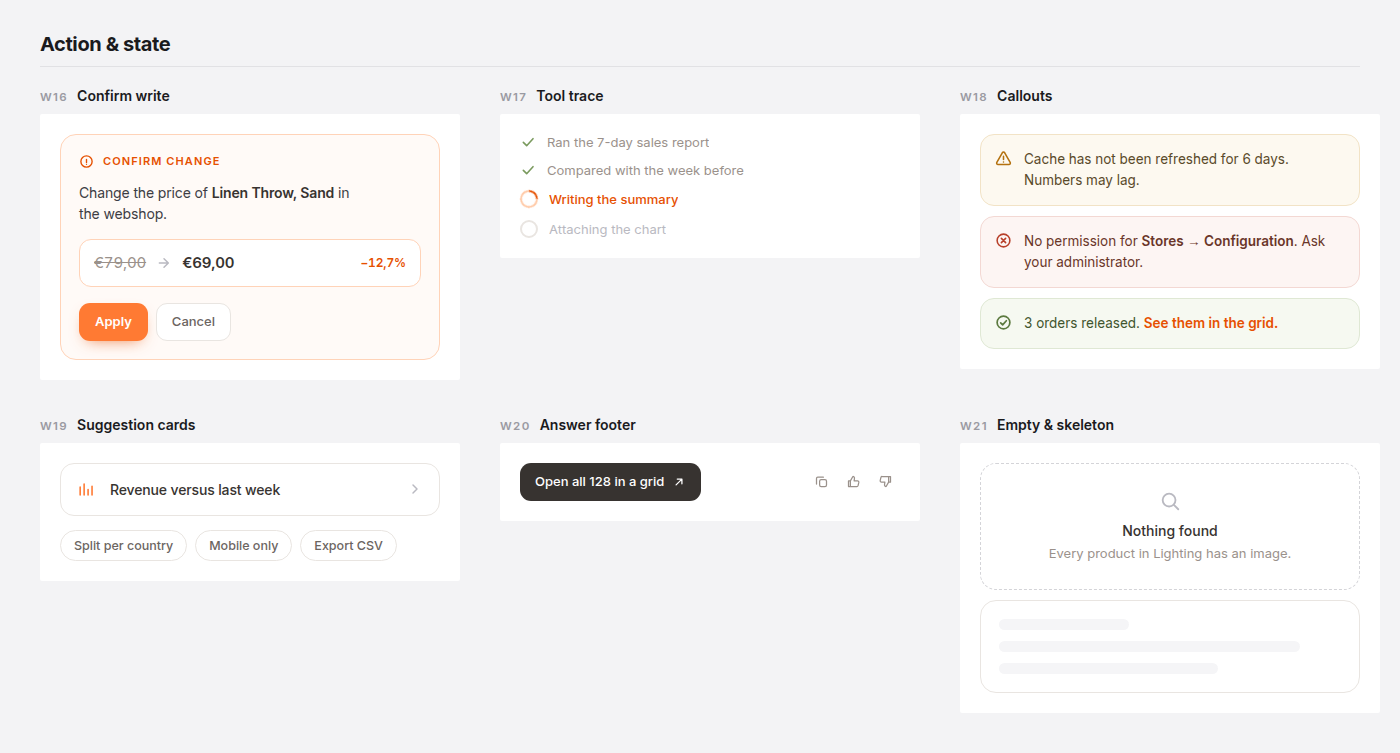
For the repetitive work there are slash commands: /cache flush or /index reindex run directly, without an AI round-trip.
Customer data stays in your store
An AI assistant in your admin raises an obvious question: what leaves your server? With Mago, not your customers. Names, email addresses, phone numbers and addresses are stripped from every lookup before anything goes to the AI provider. Order and customer numbers become placeholders, and a field that a skill has not explicitly marked as safe is never sent. Conversations are stored with the placeholders, not the real values, and are deleted automatically after 90 days.
There is also no Mago server in between. Requests go straight from your store to the provider you pick. If you want everything in the EU, or on your own hardware, you can use Azure OpenAI in an EU region or run a local model through Ollama or LM Studio. Haimanti Dekker of Linted built this privacy layer and wrote about the choices behind it (in Dutch).
Free, open source and no vendor lock-in
Mago is MIT-licensed: no licence fee, no seats, no subscription. You bring your own API key and only pay your AI provider for what you use. Claude, OpenAI, Gemini, OpenRouter or a local model, and you can switch providers whenever you like.
That provider flexibility comes from mage-os/module-ai-base, which we built as a separate module. You configure your AI provider in one place, token usage is reported per module and store, and any other module that needs AI can use the same base instead of shipping its own integration.
Mago itself follows the same idea. The core ships with the essentials: analytics, configuration, content and admin navigation as built-in skills. Everything else is an addon, a small module that teaches Mago a new trick through its skill API, without touching core. Any agency or module vendor can build one, and the first ones exist already: a VAT number check through VIES, a Dutch Chamber of Commerce lookup built on top of it, and an integration with RUMvision is in the works. That is how Mago stays a community effort instead of one vendor's roadmap.
Your competitor reviews the code
Developers from five agencies worked on Mago, on one shared backlog, every week. Every pull request is read by a developer from another agency before it merges, so nobody gets to wave their own code through. That is a difference you notice the moment you have to explain a technical choice. Someone from another team knows your project less well, and exactly because of that, they can spot where your solution leans on an assumption that doesn't hold for their webshop.
The pace surprised us too. What started in April at Hyvä Developers Paradise without a plan became a decision at the Mage Unconference in June, and a product you dare to install during the Mage-OS hackathon in Zwolle in September. From the first commit to version 1.0 took 104 days, with 22 people writing, reviewing and testing code.

The quality bar is just as strict as the review process: every change runs PHPStan at level 8, the Magento coding standard, unit tests and end-to-end browser tests. For a module that gets to read your store data, that transparency matters. Every line is on GitHub, for you or your developer to read.
Mage-OS made this possible as the neutral ground between agencies. It preserves Magento releases, maintains its own distribution, and through Mage-OS Labs gives developers a place to build and test new modules together. I wrote about the difference between Mage-OS and Mage-OS NL before.
Where to get it
Mago and the AI base module ship with Mage-OS 4.0.0. The assistant is disabled by default, and you decide which AI provider to configure. For Magento Open Source (2.4.8 and up), Mago is available as a standalone module. You can read more in the Mage-OS 4.0.0 release notes.
For me, this is the value of Mage-OS. You take a problem from your daily work, build on it with developers from other agencies, and make the result available to people you have never met. They can use the assistant, read the code and build their own addons. The next module that needs an AI provider can build on the integration that is already there.
Want to try Mago yourself or see how it works under the hood? Take a look at askmago.com.


